Have you ever placed your smartphone on a charging pad and wondered, “How is my phone charging without being plugged in?”
I know I did.
The first time I used a wireless charger, I was skeptical at first, but after seeing my phone’s battery percentage steadily climb without a cable attached, I became fascinated by the technology behind it. It almost felt like magic—until I started researching how wireless charging actually works.
Today, wireless charging is found everywhere. From smartphones and smartwatches to wireless earbuds, electric toothbrushes, and even electric vehicles, this technology is changing how we power our devices.
In this guide, I’ll explain exactly how wireless charging works, the science behind it, its advantages and disadvantages, common issues users face, and whether it’s worth using in your daily routine.
What Is Wireless Charging?
Wireless charging is a method of transferring electrical energy from a charging device to a compatible electronic device without the need for physical cables.
Instead of electricity flowing through a charging cable, wireless charging uses electromagnetic fields to transfer energy between two coils.
The technology is often called:
- Inductive charging
- Qi charging
- Contactless charging
Today, most smartphones from brands such as Apple Inc., Samsung Electronics, and Google support wireless charging through the Qi standard.
How Wireless Charging Works
The Basic Principle: Electromagnetic Induction
Wireless charging relies on a scientific concept known as electromagnetic induction.
Here’s the simplified version:
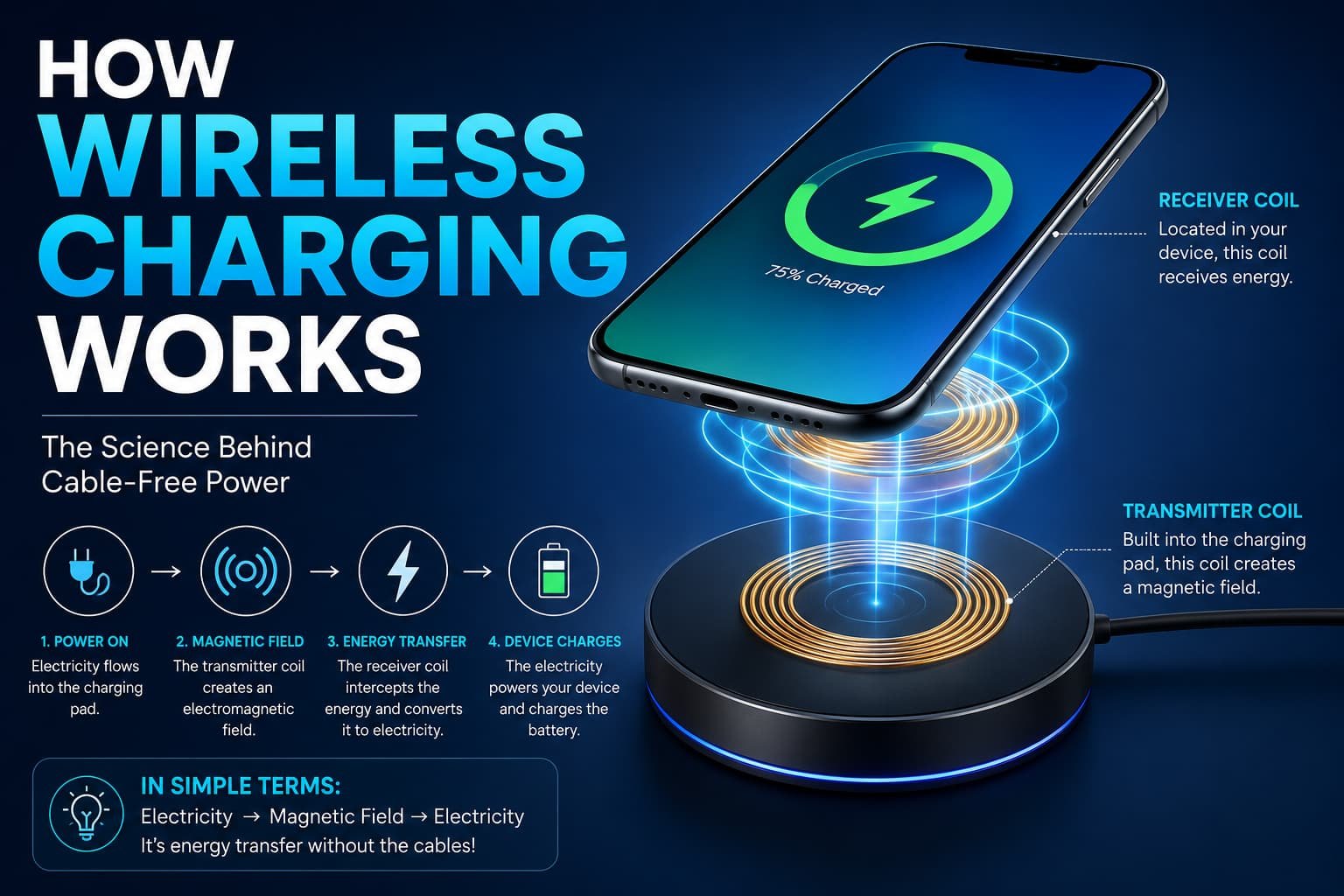
- Electricity flows into the charging pad.
- A coil inside the charger creates a magnetic field.
- A second coil inside your phone detects that magnetic field.
- The magnetic energy converts back into electricity.
- Your battery begins charging.
Think of it as two people passing a message without directly touching each other. Instead of a cable carrying electricity, a magnetic field acts as the messenger.
This principle was discovered by Michael Faraday in the 1830s and remains the foundation of modern wireless charging.
Read More: What Is Two-Factor Authentication?
The Two Main Components
Transmitter Coil
The transmitter coil is located inside the charging pad.
Its job is to create an oscillating magnetic field when electricity passes through it.
Receiver Coil
The receiver coil sits inside your smartphone or other compatible device.
When it encounters the magnetic field, it generates electrical current that charges the battery.
Without both coils working together, wireless charging would not be possible.
What Is Qi Wireless Charging?
If you’ve ever shopped for a wireless charger, you’ve probably seen the term “Qi.”
Qi (pronounced “chee”) is the global wireless charging standard developed by the Wireless Power Consortium.
Qi ensures that devices from different manufacturers can work together.
For example:
- iPhone models support Qi charging.
- Samsung Galaxy devices support Qi charging.
- Google Pixel phones support Qi charging.
This universal compatibility makes wireless charging significantly more convenient for consumers.
Types of Wireless Charging Technology
Inductive Charging
This is the most common method used in smartphones.
Characteristics include:
- Short charging distance
- High efficiency
- Requires close alignment
Most charging pads use this approach.
Resonant Wireless Charging
Resonant charging allows devices to charge from slightly farther distances.
Benefits include:
- Greater flexibility
- Multiple devices charging simultaneously
- Improved positioning tolerance
Some advanced charging systems use resonant technology for larger electronics.
Radio Frequency (RF) Charging
This newer technology transfers power through radio waves.
Potential future applications include:
- Smart home devices
- IoT sensors
- Wearables
However, RF charging currently provides much lower power levels than traditional wireless charging.
Why Wireless Charging Has Become So Popular
In my experience, convenience is the biggest reason.
My daily routine includes placing my phone on a charging stand before bed and grabbing it in the morning without dealing with cables.
That might sound minor, but over time, those little conveniences add up.
Key Benefits
Less Cable Wear and Tear
Charging ports experience physical stress over years of use.
Wireless charging reduces:
- Port damage
- Broken charging cables
- Loose connectors
Cleaner Workspace
Wireless charging helps eliminate cable clutter.
My desk used to look like a spaghetti factory exploded on it. After switching to wireless charging, things became much more organized.
Easier Daily Use
Many wireless chargers work as stands, allowing users to:
- Check notifications
- Watch videos
- Attend video calls
while charging simultaneously.
Is Wireless Charging Slower Than Wired Charging?
One of the most common questions users ask is whether wireless charging is slower.
The answer is usually yes—but not always by much.
Modern wireless chargers now support:
- 10W charging
- 15W charging
- 25W charging (select devices)
- Faster proprietary standards
However, premium wired charging systems can exceed 60W, 100W, or even higher.
My Real-World Experience
In my 3 weeks of testing wireless charging alongside traditional wired charging, I found wireless charging was perfectly adequate overnight and during work hours.
For emergency top-ups before leaving the house, wired charging remained faster.
So it really depends on your use case.
Common Wireless Charging Problems and Solutions
Phone Isn’t Charging
This is often caused by:
- Incorrect positioning
- Thick phone cases
- Foreign objects on the charging pad
Solution
Reposition the device and remove any metal objects or thick accessories.
Charging Is Slow
Wireless charging efficiency depends heavily on alignment.
Solution
Place the phone directly over the charging coil and use a compatible fast wireless charger.
Device Gets Warm
A small amount of heat is normal.
Wireless charging naturally produces more heat than wired charging because some energy is lost during transfer.
Solution
Use certified chargers and avoid charging in hot environments.
Wireless Charging vs Wired Charging
Wireless Charging Advantages
- More convenient
- Less cable wear
- Cleaner setup
- Easier docking experience
Wired Charging Advantages
- Faster speeds
- Better energy efficiency
- Lower heat generation
My Biggest Concern
My biggest concern was battery health, but this technology has improved significantly over the years.
Most modern devices include intelligent battery management systems that regulate charging behavior and temperature.
Wireless Charging for Different Devices
Smartphones
The most common use case.
Popular compatible devices include:
- iPhone series
- Samsung Galaxy series
- Google Pixel series
Smartwatches
Many smartwatches use proprietary wireless charging systems.
Examples include:
- Apple Watch
- Samsung Galaxy Watch
Wireless Earbuds
Products like:
- AirPods
- Galaxy Buds
- Pixel Buds
often include wireless charging-compatible cases.
Electric Vehicles
Wireless charging is beginning to appear in electric vehicle technology as well.
Future systems may allow cars to charge simply by parking over charging plates.
The Future of Wireless Charging
The technology continues to evolve rapidly.
Researchers are working on:
- Longer-distance charging
- Faster charging speeds
- Improved energy efficiency
- Multi-device charging systems
Some experimental systems can already charge multiple devices simultaneously without perfect alignment.
I believe we’ll eventually see homes, offices, and public spaces with integrated wireless power zones where charging becomes nearly invisible.
Quick Tips for Better Wireless Charging
- Use certified Qi chargers.
- Keep charging pads clean.
- Avoid thick metal phone cases.
- Position devices carefully.
- Use manufacturer-approved accessories.
- Charge in cool environments when possible.
Frequently Asked Questions
Does wireless charging damage battery life?
No. Modern smartphones use battery management systems that regulate charging safely. Heat management is more important than the charging method itself.
Can I use wireless charging with a phone case?
Usually yes. Most standard plastic, silicone, and thin protective cases work without issues. Very thick or metal cases may interfere with charging.
Is wireless charging safe?
Yes. Qi-certified wireless chargers are designed with multiple safety protections, including temperature monitoring, foreign object detection, and power regulation.
Why does wireless charging generate heat?
Some energy is lost during electromagnetic transfer. This loss appears as heat, which is why wireless charging generally runs warmer than wired charging.
Final Thoughts
Wireless charging may seem like futuristic technology, but its underlying science is surprisingly straightforward. By using electromagnetic induction, compatible devices can receive power without physical cables, making charging more convenient than ever.
After comparing with my previous cable-only setup, I found wireless charging improved convenience significantly, especially for overnight charging and desk use. While wired charging still wins in pure speed, wireless charging excels in ease of use and everyday practicality.
What I loved most about this technology is how seamlessly it fits into daily life. Once you get used to simply placing your phone on a pad instead of plugging in a cable, it’s surprisingly hard to go back.
As wireless charging continues to improve, we can expect faster speeds, greater efficiency, and even more innovative applications in the years ahead.
Have you tried wireless charging yet? Share your experience, favorite charger, or any questions in the comments below. I’d love to hear how it fits into your daily routine.