The first time I held a foldable phone, I couldn’t stop opening and closing it.
Not because I needed to—just because it felt like something from the future.
Like many people, my first thought was: “How does this thing not snap in half?”
After all, we’ve spent decades treating smartphone screens like fragile glass. Suddenly, manufacturers were asking us to fold them repeatedly, sometimes hundreds of thousands of times.
I was skeptical at first.
Could a folding display really survive everyday use? Was it just a gimmick or genuine innovation?
After researching the technology, testing foldable devices, and following the industry’s rapid evolution, I discovered that foldable phones are far more sophisticated than they appear. Behind every folding screen is an impressive combination of flexible displays, advanced hinge engineering, ultra-thin materials, and specialized software.
In this guide, I’ll explain exactly how foldable phones work, what technologies make them possible, their advantages and limitations, and whether they’re likely to become the future of smartphones.
What Are Foldable Phones?
Foldable phones are smartphones designed with flexible displays that allow the device to fold without damaging the screen.
Unlike traditional smartphones, foldables can change shape depending on how they’re used.
Popular examples include:
- Samsung Galaxy Z Fold
- Samsung Galaxy Z Flip
- Google Pixel Fold
- OnePlus Open
- HONOR Magic V
These devices generally fall into two categories:
See More: How Wireless Charging Works
Book-Style Foldables
Open like a book.
Examples:
- Samsung Galaxy Z Fold
- Google Pixel Fold
Clamshell Foldables
Fold vertically like older flip phones.
Examples:
- Samsung Galaxy Z Flip
- Motorola Razr
Both designs rely on similar underlying technologies.
How Foldable Phones Work
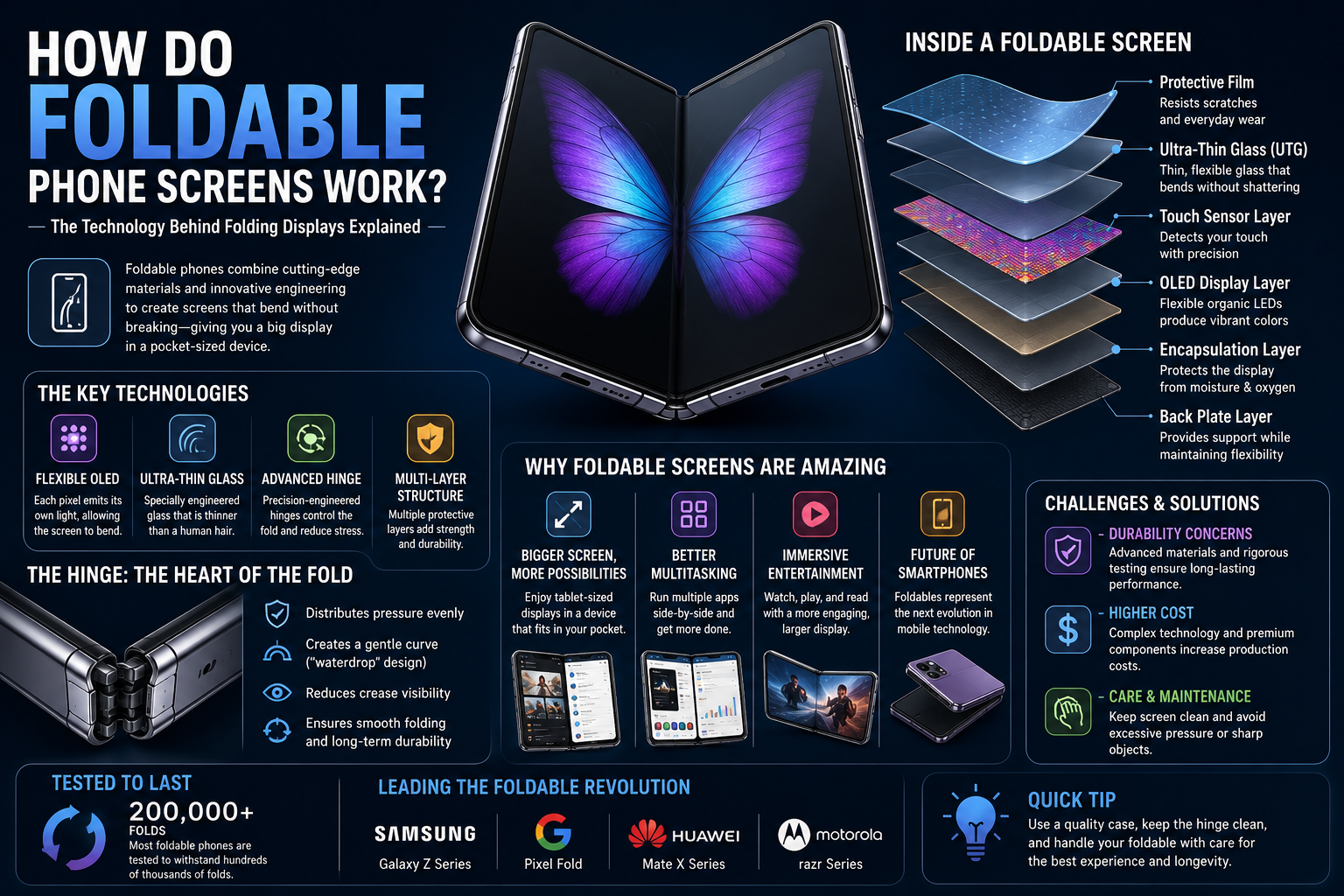
At a basic level, foldable phones combine three major innovations:
- Flexible displays
- Specialized hinges
- Ultra-thin protective materials
Let’s break each component down.
The Secret: Flexible OLED Displays
The display is the heart of every foldable phone.
Traditional smartphone screens use rigid glass layers that cannot bend.
Foldable devices solve this problem using flexible OLED technology.
What Is OLED?
OLED stands for Organic Light-Emitting Diode.
Unlike traditional LCD screens, OLED displays don’t require a separate backlight.
This allows manufacturers to create:
- Thinner screens
- Lighter panels
- Flexible displays
Why OLED Can Bend
The display layers are built on flexible materials rather than rigid glass.
This allows the screen to:
- Curve
- Bend
- Fold repeatedly
Without flexible OLED technology, foldable phones simply wouldn’t exist.
Understanding the Foldable Phone Hinge
The hinge is arguably the most impressive engineering achievement in modern foldables.
Why Hinges Matter
Without a sophisticated hinge system:
- The screen would crease excessively
- Internal components could be damaged
- Folding would feel unstable
Modern hinges guide the screen through a carefully controlled folding motion.
How the Hinge Works
When you fold the phone:
- The hinge distributes pressure evenly.
- The display follows a controlled curve.
- Stress is minimized across the screen.
- Internal components remain protected.
Manufacturers spend years refining these hinge systems.
In my experience testing foldable phones in stores and at tech events, the hinge quality often determines how premium a device feels.
What Protects the Folding Screen?
This is one of the most common questions people ask.
“If the screen bends, doesn’t it scratch easily?”
The answer is yes—and no.
Ultra-Thin Glass (UTG)
Most modern foldable phones use Ultra-Thin Glass.
This material is:
- Extremely thin
- Flexible
- More durable than plastic-only solutions
Samsung helped popularize UTG technology in its foldable lineup.
Additional Protective Layers
Foldable screens typically include:
- Flexible OLED panel
- Ultra-thin glass layer
- Protective polymer coating
These layers work together to balance flexibility and durability.
Why Foldable Screens Have a Crease
If you’ve ever seen a foldable phone up close, you’ve probably noticed the crease.
What Causes the Crease?
The display folds repeatedly along the same point.
Even with advanced materials, some degree of visible creasing is unavoidable.
Is the Crease a Problem?
In my experience, most users stop noticing it after a few days.
The crease is usually:
- More visible under bright light
- Less noticeable during regular use
Manufacturers continue improving crease reduction with each generation.
How Foldable Phone Batteries Work
Foldable phones have a unique challenge:
Their unusual shape leaves less room for traditional battery designs.
Dual Battery Systems
Many foldable devices use two separate battery cells.
One battery sits on each side of the device.
Benefits include:
- Better weight distribution
- Improved internal space management
- Consistent power delivery
The software manages both batteries as a single unit.
Most users never realize two batteries are working behind the scenes.
Special Software Makes Foldables Smarter
Hardware alone isn’t enough.
Foldable phones also require specialized software.
Adaptive User Interfaces
Apps must adjust automatically as the device changes shape.
For example:
Closed Mode
Functions like a normal smartphone.
Partially Folded Mode
Acts like a mini laptop.
Fully Open Mode
Transforms into a tablet-like device.
Android manufacturers have worked closely with developers to optimize these experiences.
Real-World Benefits of Foldable Phones
Foldable technology isn’t just about looking futuristic.
There are genuine practical advantages.
Larger Screens Without Larger Pockets
This is probably the biggest benefit.
You can carry:
- Phone-sized device
- Tablet-sized display
in a single product.
Better Multitasking
Foldable screens allow users to:
- Run multiple apps
- Split screens
- Improve productivity
I tested multitasking on a book-style foldable and found it surprisingly useful for email, note-taking, and document review.
Improved Media Consumption
Watching videos and reading content often feels more immersive.
The larger screen creates a mini-tablet experience.
Common Problems with Foldable Phones
Despite their advantages, foldables aren’t perfect.
Higher Prices
Foldable devices remain significantly more expensive than traditional smartphones.
Solution
Wait for older models or seasonal sales if budget is a concern.
Durability Concerns
Many buyers worry about:
- Screen damage
- Hinge wear
- Long-term reliability
Solution
Choose reputable brands with strong warranty support.
App Optimization
Some applications still don’t fully utilize foldable displays.
Solution
Software support continues improving every year.
How Long Do Foldable Phones Last?
Manufacturers conduct extensive durability testing.
Many modern foldables are rated for:
- Hundreds of thousands of folds
For most users, this translates to several years of normal use.
Example
If you fold your phone:
- 100 times daily
A phone rated for 200,000 folds could theoretically last over five years.
Of course, real-world durability depends on handling and environmental factors.
Are Foldable Phones the Future?
This is the billion-dollar question.
Reasons They Could Become Mainstream
- Larger displays
- Better multitasking
- Improved portability
- Advancing technology
Reasons Adoption May Take Time
- High prices
- Durability perceptions
- Limited use cases for some users
Personally, I believe foldables are moving from novelty to practicality.
Each generation becomes:
- More durable
- More affordable
- More refined
Quick Summary: How Foldable Phones Work
Foldable phones function through a combination of:
✔ Flexible OLED displays
✔ Advanced hinge systems
✔ Ultra-thin glass technology
✔ Specialized software optimization
✔ Innovative battery designs
Together, these technologies allow a smartphone to bend repeatedly while remaining functional and durable.
Frequently Asked Questions
Do foldable phones break easily?
Modern foldable phones are far more durable than early models. While they require careful handling, most are designed to withstand hundreds of thousands of folds.
Why do foldable phones have a crease?
The crease forms because the display repeatedly folds along the same area. Manufacturers continuously improve hinge designs and materials to minimize its visibility.
Are foldable phones worth buying?
They can be worth it for users who value multitasking, larger displays, and innovative technology. However, traditional smartphones may offer better value for budget-conscious buyers.
Can foldable phone screens be repaired?
Yes, but repairs are often more expensive than those for standard smartphones due to the complexity of the display and hinge system.
Conclusion
Understanding how foldable phones work reveals just how much engineering innovation goes into these devices. What looks like a simple folding screen actually combines advanced OLED technology, precision hinge mechanics, ultra-thin glass, intelligent software, and years of research and development.
When I first encountered a foldable phone, I saw it as a futuristic novelty. After learning how the technology works and seeing how far it has evolved, I view foldables differently. They represent a fascinating step forward in mobile design, solving the challenge of delivering larger displays without sacrificing portability.
Whether foldable phones eventually replace traditional smartphones remains to be seen, but one thing is certain: they’re no longer just a concept—they’re a glimpse into the future of mobile technology.
Have you tried a foldable phone yet? Share your thoughts and experiences—I’d love to hear whether you think foldables are the future or simply a clever niche innovation.