Content marketing sounds simple on paper: create content, publish it, and attract customers.
But if you’ve ever spent hours writing blog posts, creating social media content, or recording videos only to see little engagement, you know it’s not that straightforward.
I learned this lesson the hard way.
A few years ago, I helped a small business publish content consistently for several months. We were posting blogs, sharing updates on social media, and even experimenting with videos. Yet traffic barely moved, leads remained flat, and the return on effort was disappointing.
The problem wasn’t the content itself.
The problem was that we didn’t have a content marketing strategy.
Once we developed a clear plan—understanding our audience, setting goals, creating targeted content, and measuring performance—the results improved dramatically.
In this guide, I’ll walk you through exactly how to create a content marketing strategy based on proven principles, practical experience, and real-world examples.
Whether you’re a business owner, marketer, freelancer, or creator, this framework can help you create content with purpose instead of simply publishing for the sake of publishing.
Why a Content Marketing Strategy Matters
Before diving into the process, it’s important to understand why strategy comes first.
Many businesses focus on creating content before defining their objectives.
That often leads to:
- Inconsistent messaging
- Low engagement
- Wasted marketing budget
- Poor lead generation
- Difficulty measuring success
A content marketing strategy serves as your roadmap. It ensures every piece of content supports a larger business goal.
According to the Content Marketing Institute, organizations with documented content strategies are generally more likely to report successful marketing outcomes than those without one.
The difference isn’t luck—it’s planning.
Read More: What Is Topical Authority in SEO?
What Is a Content Marketing Strategy?
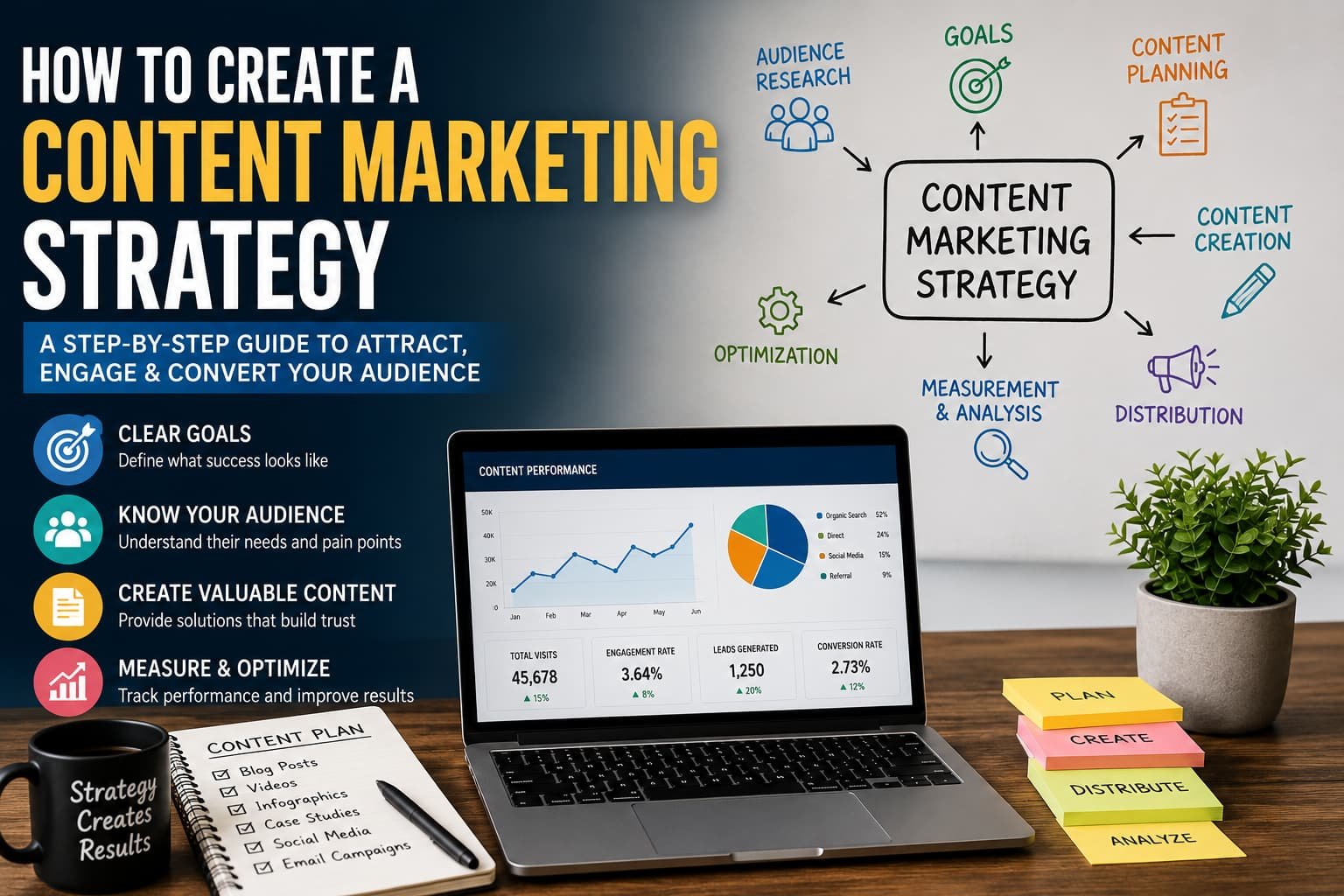
A content marketing strategy is a documented plan that outlines:
- Your target audience
- Business goals
- Content topics
- Distribution channels
- Content formats
- Performance metrics
Think of it as the blueprint that guides every article, video, social media post, email, or downloadable resource you create.
Without strategy, content becomes random.
With strategy, content becomes a growth asset.
Step 1: Define Clear Business Goals
One of the biggest mistakes I see is creating content without a measurable objective.
Before creating anything, ask yourself:
“What do I want this content to accomplish?”
Common content marketing goals include:
Brand Awareness
If people don’t know your brand exists, content can help increase visibility.
Examples:
- Educational blog posts
- Social media content
- YouTube videos
- Industry thought leadership
Lead Generation
Many businesses use content to attract potential customers.
Examples:
- Free guides
- Checklists
- Webinars
- Email newsletters
Customer Retention
Content isn’t only for attracting new customers.
It can also:
- Improve loyalty
- Reduce churn
- Increase repeat purchases
In my experience, content performs significantly better when every piece supports one primary objective.
Step 2: Understand Your Target Audience
This step often determines whether your strategy succeeds or fails.
You can create amazing content, but if it’s aimed at the wrong audience, it won’t deliver results.
Build Audience Personas
Create detailed customer profiles that include:
- Age range
- Industry
- Job role
- Interests
- Pain points
- Goals
- Preferred platforms
For example:
A small business owner might search:
- “How to generate more leads”
- “Best marketing tools”
- “How to improve SEO”
Meanwhile, a marketing manager may search:
- “Content ROI metrics”
- “Marketing automation software”
- “Enterprise content strategy”
The content needs are completely different.
Use Real Data
Some useful tools include:
- Google Analytics
- Google Search Console
- HubSpot
- Semrush
- Ahrefs
I was skeptical at first about spending time researching audience behavior, but it consistently became one of the highest-impact activities in every content project I worked on.
Step 3: Perform Content and Competitor Research
Before creating content, identify what’s already working.
Analyze Competitors
Look at:
- Popular blog posts
- Top-performing videos
- Social engagement
- Keyword rankings
Tools like Semrush and Ahrefs can reveal valuable insights into competitor strategies.
Identify Content Gaps
Ask questions such as:
- What topics are competitors missing?
- Which questions remain unanswered?
- What information could be explained better?
This helps you create content that adds unique value rather than repeating what’s already available.
Step 4: Build a Keyword Strategy
Keywords remain one of the foundations of successful content marketing.
Focus on Search Intent
Rather than targeting broad keywords, focus on user intent.
For example:
Instead of targeting:
“marketing”
Target:
- How to create a content marketing strategy
- Content marketing strategy examples
- Content planning framework
- Content marketing tips for small businesses
These long-tail keywords often attract more qualified traffic.
Use Keyword Research Tools
Popular options include:
- Google Keyword Planner
- Ahrefs
- Semrush
- Ubersuggest
The goal isn’t simply finding keywords.
The goal is understanding what people are trying to accomplish when they search.
Step 5: Choose the Right Content Formats
Not all audiences consume content the same way.
Some prefer reading.
Others prefer watching.
Others want quick answers.
Blog Content
Best for:
- SEO
- Education
- Long-form explanations
Video Content
Best for:
- Demonstrations
- Tutorials
- Product showcases
Platforms:
- YouTube
- TikTok
- Instagram Reels
Email Marketing
Excellent for:
- Nurturing leads
- Building relationships
- Driving repeat engagement
Case Studies
One content format that consistently performs well is the case study.
Real examples build trust and demonstrate expertise.
For instance, HubSpot regularly publishes customer success stories that show measurable results, making their content highly persuasive.
Step 6: Create a Content Calendar
Without a publishing schedule, consistency becomes difficult.
A content calendar helps organize:
- Topics
- Deadlines
- Authors
- Publication dates
- Promotion plans
Simple Publishing Framework
For example:
Week 1:
- Educational blog post
Week 2:
- Video tutorial
Week 3:
- Case study
Week 4:
- Industry trend analysis
Consistency often beats intensity.
Publishing quality content regularly usually outperforms publishing large volumes sporadically.
Step 7: Develop High-Quality Content
Creating content isn’t enough.
Creating useful content is what matters.
Google increasingly rewards content that demonstrates:
- Experience
- Expertise
- Authority
- Trustworthiness
This is often referred to as EEAT.
Focus on Real Experience
Whenever possible:
- Share lessons learned
- Include personal insights
- Use examples
- Reference actual outcomes
For example, one of the biggest improvements I noticed was adding practical examples and firsthand observations instead of relying solely on theory.
Readers tend to connect more strongly with real experiences.
Step 8: Promote Your Content
A common misconception is that publishing equals marketing.
It doesn’t.
Content promotion is just as important as content creation.
Effective Distribution Channels
Consider:
- Email newsletters
- X (Twitter)
- Industry communities
- Forums
- Partnerships
Many marketers follow the “create once, distribute multiple times” approach.
A single blog post can become:
- Social media posts
- Videos
- Infographics
- Email content
- Podcast discussion points
This maximizes return on effort.
Step 9: Measure Performance and Optimize
You cannot improve what you don’t measure.
Track key performance indicators (KPIs) such as:
Traffic Metrics
- Organic visitors
- Page views
- Traffic sources
Engagement Metrics
- Time on page
- Bounce rate
- Social shares
Conversion Metrics
- Leads generated
- Email signups
- Sales attributed to content
Helpful Analytics Tools
- Google Analytics 4
- Search Console
- HubSpot
- Semrush
The best content marketers continuously test, learn, and refine.
Common Content Marketing Challenges (And How to Solve Them)
Problem: No Traffic
Solution:
- Improve SEO
- Target long-tail keywords
- Build backlinks
- Update existing content
Problem: Low Engagement
Solution:
- Focus on audience pain points
- Improve headlines
- Add visuals
- Use storytelling
Problem: Inconsistent Publishing
Solution:
- Create a content calendar
- Batch content creation
- Repurpose existing content
Problem: No Conversions
Solution:
- Improve calls-to-action
- Align content with buyer intent
- Create stronger lead magnets
Quick Tips for Better Content Marketing Results
- Start with audience research, not content ideas.
- Focus on solving specific problems.
- Prioritize quality over quantity.
- Repurpose successful content.
- Track performance monthly.
- Update older content regularly.
- Create content for every stage of the buyer journey.
Frequently Asked Questions
1. How long does it take for a content marketing strategy to work?
Content marketing is typically a long-term investment. While some results can appear within a few weeks, meaningful SEO and lead-generation outcomes often take three to six months or longer, depending on competition and consistency.
2. What is the most important part of a content marketing strategy?
Understanding your audience is arguably the most important factor. If you know your audience’s needs, challenges, and goals, creating effective content becomes much easier.
3. How often should I publish content?
There is no universal rule. Consistency matters more than frequency. Publishing one high-quality article per week often delivers better results than publishing multiple low-quality pieces.
Conclusion
Creating a content marketing strategy isn’t about producing more content—it’s about creating smarter content.
The most successful strategies begin with clear goals, deep audience understanding, keyword research, consistent publishing, and ongoing optimization.
In my experience, businesses often see the biggest improvements when they stop chasing content volume and start focusing on purpose. Every blog post, video, email, or social media update should have a clear role within the larger marketing plan.
If you’re building a content marketing strategy today, start small. Define your audience, choose a few core topics, create a realistic content calendar, and measure what works.
Over time, those consistent efforts can compound into stronger visibility, greater trust, higher engagement, and meaningful business growth.