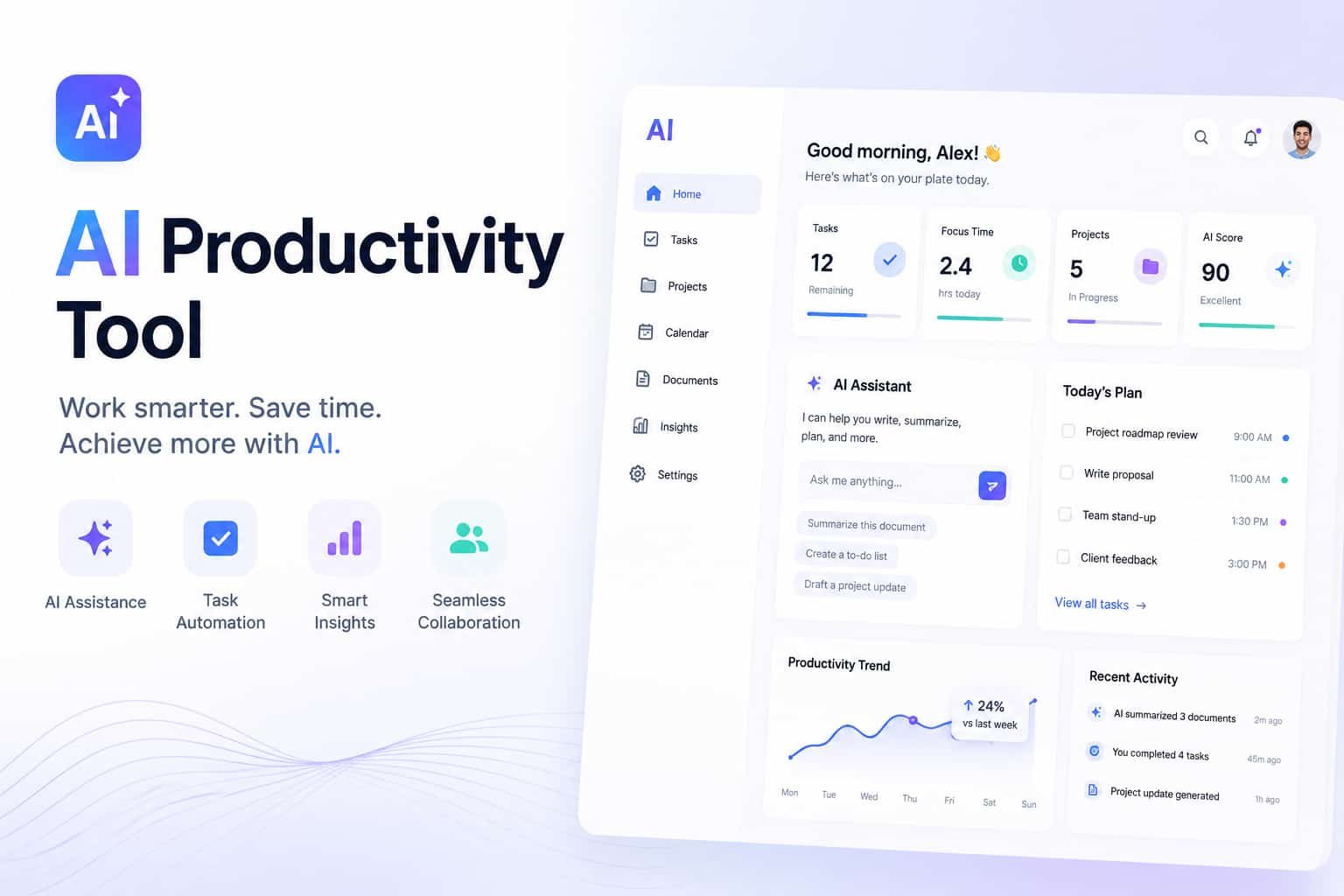
I’ve been testing and using AI Productivity tools for years now, and 2026 feels like a genuine leap forward. What started as clever chatbots has evolved into intelligent agents, seamless automations, and creative partners that handle complex workflows.
In my experience, the real game-changers aren’t the flashy demos they’re the tools that quietly save hours every week when integrated into your daily routine. Whether you’re a solo creator, team lead, or business owner, there’s something here for you.
I’ll walk you through the best options by category, based on hands-on testing and real results. Let’s dive in.
From AI writing assistants to smart scheduling apps, discover how Technology Can Make Your Life Easier by improving productivity and simplifying your daily routine.
Overview for Beginners
Overview
For beginners, the best AI productivity tools in 2026 are intuitive, generally free to start, and cover essentials like writing, design, and productivity. Top choices include ChatGPT and Claude for text, Canva AI for design, Perplexity for research, and Notion AI productivity for organization. These tools offer a low barrier to entry for accelerating daily tasks.
Here are the best AI tools for beginners based on function:
- General AI Assistants & Writing (LLMs)
- ChatGPT: Best for text generation, coding, and general troubleshooting.
- Claude (Anthropic): Known for having a natural writing style and handling long documents well.
- Gemini (Google): Excellent for researching and integrating with Google apps.
- Search & Research
- Perplexity AI: A conversational search engine that provides cited, accurate answers, making it a powerful alternative to traditional search.
- NotebookLM (Google): Ideal for analyzing PDFs, notes, and documents to summarize or find specific information.
- Design & Creative
- Canva AI (Magic Design): Easiest tool for creating social media graphics, presentations, and posters with simple text prompts.
- Leonardo.ai: A user-friendly AI productivity image generator for creating high-quality visuals.
Start with one or two of these, play around, and build from there. You don’t need to master everything at once.
1. AI Orchestration and Automation: The Control Center
Individual AI tools are powerful, but the real magic happens when they work together. In 2026, orchestration platforms connect everything seamlessly.
Zapier stands out as my top pick for AI productivity orchestration and automation. It connects to over 8,000 apps and lets you build smart workflows with natural language.
In my experience, Zapier’s Copilot is fantastic—you describe what you want (“summarize new leads in Slack every morning”), and it drafts the full automation, maps data, and tests it. Zapier Agents act as self-directed teammates for multi-step tasks like drafting reports or handling customer responses. Features like built-in AI actions, custom chatbots, and Tables for data storage make it a complete productivity hub.
Actionable Tip: Start with simple Zaps and gradually add agents. It transforms scattered tools into a unified system.
2. AI Chatbots: Your Everyday Reasoning Partners
Chatbots have matured into versatile thinkers capable of coding, math, and deep analysis.
- ChatGPT remains the industry leader. It’s flexible, great for marketing copy, research, sales emails, and now even stronger image generation and agentic tasks.
- Claude shines with its natural writing style, long-context handling, and Artifacts feature for building interactive interfaces or documents side-by-side.
- Meta AI excels if you’re deep in social platforms, offering image editing and context from your Meta apps (with privacy considerations in mind).
I switch between them depending on the task—Claude for thoughtful writing, ChatGPT for quick versatility.
3. AI Agent Builders: From Conversation to Action
Agents go beyond chatting—they take real actions across your apps.
Zapier Agents top my list here because of the massive integration ecosystem. You train them on your data sources and let them handle inbox management, reporting, or customer queries autonomously.
Botpress is excellent for more complex, developer-friendly custom bots with visual builders and strong knowledge base support. In 2026, these agents feel like true digital teammates.
4. AI Search Engines: Goodbye Hallucinations
Reliable research is crucial, and these tools ground answers in real sources.
Perplexity is my daily driver for its cited, on-topic responses and follow-up capabilities. It pairs beautifully with traditional search.
Komo offers great customization with personas and deep research modes. Brave delivers privacy-focused, accurate summaries without tracking you.
5. Content Creation Tools
Writer’s block meets its match with these specialized platforms.
Jasper excels for high-volume business content with templates and research features. Anyword is perfect for marketers optimizing ad and social copy. Writer stands out for enterprise compliance and brand voice consistency.
Tip: Always review AI output with your human judgment—it’s a co-pilot, not a replacement.
6. Grammar Checkers and Rewording Tools
- Grammarly: The all-rounder for tone, clarity, and suggestions across apps.
- Wordtune: Ideal for rewriting, shortening, or expanding text with alternatives.
- ProWritingAid: Great for creative writers with deep style analytics and lifetime plans.
7. Video Creation and Editing
Video AI has improved dramatically.
Runway (with Gen-4) is a favorite for filmmakers—generate, edit, and style-consistently with text and references. Descript revolutionizes editing by letting you edit video like a text document. Google Veo 3 produces stunning cinematic clips from prompts, complete with sound and lip sync.
8. Image Generation
ChatGPT offers simple, high-quality generation with great iteration. Midjourney delivers the most artistic results. Ideogram excels at accurate text within images.
9. Vibe-Coding Tools
You no longer need to code to build apps.
Lovable provides an intuitive, transparent process from idea to prototype. Bolt adds more control and integrations for production-ready work.
10. Social Media Management
FeedHive shines for content recycling and smart posting. Flick helps with brainstorming and drafting via its Iris assistant. Buffer tailors posts perfectly to each platform.
11. Voice and Music Generation
ElevenLabs leads with high-quality voices and sound effects. Hume lets you design emotional, nuanced voices from prompts. Speechify is perfect for turning text into natural narration.
12. Knowledge Management and Grounding
Mem auto-organizes notes intelligently. Notion AI grounds answers in your workspace data. Evernote cleans up messy ideas and scans documents effectively.
13. Task and Project Management
Asana identifies risks and answers project questions. ClickUp offers a full AI suite with Brain and Autopilot agents. Hive generates entire project plans from a single prompt.
14. Transcription and Meeting Assistants
Fireflies tracks topics and generates action items. Avoma provides conversation analytics for sales teams. Granola works as a smart notepad alongside any video tool.
15. Scheduling Tools
Reclaim protects your focus time and habits. Clockwise optimizes team calendars. Motion prioritizes tasks intelligently onto your calendar.
16. Email Management
Shortwave offers powerful AI search and summaries for Gmail. Microsoft Copilot enhances Outlook with coaching. Gemini for Gmail integrates seamlessly with Google Workspace.
17. Slide Decks and Presentations
Canva generates full decks from prompts with easy editing. Beautiful.ai creates polished designs automatically. Gamma ensures visual consistency across slides, pages, and more.
18. Resume Builders
Teal tracks applications and matches skills. Enhancv optimizes with AI feedback and ATS scoring. Kickresume builds from scratch tailored to your industry.
Other Notable AI Productivity Tools
Keep an eye on AI browsers like Comet and Atlas, app builders like Softr, universal search tools like Dropbox Dash, screen recording with Loom AI, and content detectors like Winston AI.
Building Your AI Productivity Stack in 2026
The key lesson I’ve learned: Start small. Pick tools that solve your biggest pain points first—maybe Zapier for automation and Perplexity for research—then layer in others. Always connect them where possible for compounded gains.
Remember, these are tools, not magic. The best results come when you combine AI speed with human oversight and creativity. Review outputs, refine prompts, and stay in control.
Final Thoughts
2026 is an exciting time to be working with AI. The tools above have genuinely transformed how I (and many others) get things done saving time, sparking ideas, and opening new possibilities.
Pick one category that matters most to you right now, try a couple of tools, and build momentum. What’s your biggest productivity challenge this year? Start there, and let AI help carry the load.
The future isn’t about working harder it’s about working smarter with the right partners. Go explore, experiment, and enjoy the boost.