
If you’ve ever reviewed a business financial report, hotel performance statement, or company profit analysis, you’ve probably come across the term “GOP.” The first time I saw it, I assumed it was another complicated accounting acronym buried in a spreadsheet that only finance professionals cared about.
I was wrong.
After spending time researching business performance metrics and analyzing financial reports, I discovered that GOP is actually one of the most useful indicators of how efficiently a business is operating. Whether you’re a business owner, investor, manager, or student trying to understand financial statements, knowing what GOP means can provide valuable insight into a company’s profitability.
In this guide, I’ll explain what GOP stands for in business, how it’s calculated, why companies track it, and how it differs from other profit metrics. By the end, you’ll understand why many organizations consider GOP one of their most important performance indicators.
What Does GOP Stand for in Business?
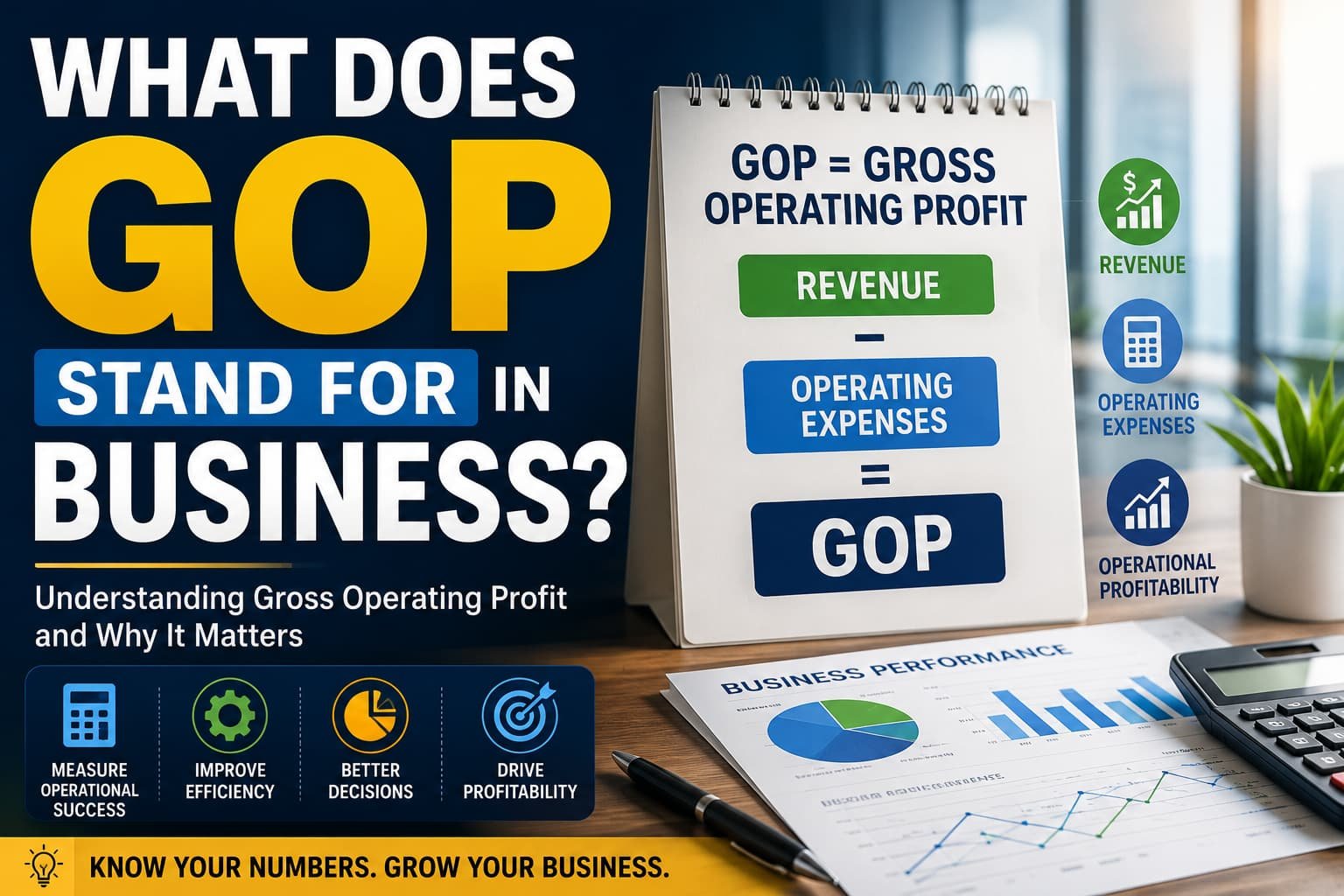
In business, GOP stands for Gross Operating Profit.
Gross Operating Profit is a financial metric that measures a company’s profitability after subtracting operating expenses from revenue but before accounting for taxes, interest, depreciation, and certain other non-operating costs.
In simple terms:
GOP shows how much profit a business generates from its core operations.
It helps business leaders evaluate whether their day-to-day operations are generating healthy profits.
Unlike net profit, which includes many additional expenses, GOP focuses specifically on operational performance.
Read More: Is Geek Bar Going Out of Business
Why Gross Operating Profit Matters
One of the biggest challenges businesses face is determining whether their operations are truly profitable.
A company might show strong revenue numbers, but revenue alone doesn’t tell the full story.
For example:
- A restaurant may generate $500,000 in monthly sales.
- A hotel may earn millions in room bookings.
- An e-commerce store may process thousands of orders.
But if operating costs are too high, those impressive sales numbers may not translate into strong profits.
That’s where GOP becomes valuable.
It helps answer a critical question:
“How efficiently is this business operating?”
How Gross Operating Profit Is Calculated
The basic formula for Gross Operating Profit is:
Gross Operating Profit = Total Revenue – Operating Expenses
Operating expenses often include:
- Employee salaries
- Utilities
- Marketing expenses
- Rent
- Maintenance costs
- Operational supplies
- Administrative costs
However, GOP generally excludes:
- Interest payments
- Taxes
- Depreciation
- Amortization
- Extraordinary expenses
The purpose is to isolate operational performance from financing and accounting decisions.
A Simple GOP Example
Let’s imagine a hotel generates:
- Revenue: $1,000,000
Operating expenses include:
- Payroll: $300,000
- Utilities: $50,000
- Marketing: $40,000
- Maintenance: $60,000
- Administrative expenses: $50,000
Total operating expenses:
$500,000
Gross Operating Profit:
$1,000,000 – $500,000 = $500,000 GOP
This means the hotel retains $500,000 from its operational activities before considering taxes, financing costs, and depreciation.
GOP vs Gross Profit: What’s the Difference?
Many people confuse Gross Profit with Gross Operating Profit.
In my experience, this is one of the most common financial misunderstandings among business beginners.
Gross Profit
Gross Profit focuses on:
Revenue minus the cost of goods sold (COGS).
Formula:
Revenue – Cost of Goods Sold
Gross Operating Profit
Gross Operating Profit goes further.
Formula:
Revenue – Operating Expenses
Because GOP includes more operating costs, it often provides a clearer picture of operational efficiency.
Think of Gross Profit as the first checkpoint and GOP as a deeper evaluation of business performance.
GOP vs Net Profit
Another common comparison is GOP versus Net Profit.
Gross Operating Profit
Measures operational profitability.
Excludes:
- Taxes
- Interest
- Depreciation
- Financing costs
Net Profit
Represents the final profit remaining after all expenses.
Includes:
- Taxes
- Interest
- Depreciation
- Other deductions
A company can have:
- Strong GOP
- Weak Net Profit
This often happens when debt payments, taxes, or depreciation expenses are high.
That’s why investors frequently examine both metrics together.
Industries That Commonly Use GOP
Although many industries use Gross Operating Profit, some rely on it more heavily than others.
Hospitality Industry
Hotels frequently use GOP as a primary performance metric.
Major hotel brands such as:
- Marriott International
- Hilton Worldwide
- Hyatt Hotels Corporation
often analyze GOP to measure property performance.
Because hotels have substantial operational expenses, GOP provides valuable insight into profitability.
Restaurants
Restaurant owners monitor GOP to evaluate:
- Labor efficiency
- Food costs
- Operating expenses
- Revenue performance
Retail Businesses
Retailers use GOP to determine whether store locations are operating profitably.
Manufacturing
Manufacturers use GOP to assess production efficiency and operational cost control.
Why Business Owners Track GOP
I was skeptical at first about why so many companies focus on GOP instead of simply looking at revenue.
After reviewing multiple business case studies, the answer became clear.
Revenue alone can be misleading.
A business generating $10 million annually isn’t necessarily healthier than one generating $5 million.
What matters is how efficiently each company converts revenue into profit.
GOP helps business owners:
- Identify cost issues
- Compare performance across locations
- Monitor profitability trends
- Improve operational efficiency
- Make smarter budgeting decisions
How to Improve Gross Operating Profit
Improving GOP generally requires one of two approaches:
- Increase revenue
- Reduce operating expenses
The strongest businesses often focus on both.
Increase Revenue
Strategies include:
Improve Customer Retention
Keeping existing customers is often cheaper than acquiring new ones.
Upsell Products and Services
Businesses can increase average transaction value through strategic upselling.
Expand Offerings
Adding complementary products or services can create additional revenue streams.
Reduce Operating Costs
Optimize Staffing
Proper scheduling can reduce unnecessary labor expenses.
Improve Energy Efficiency
Lower utility costs can improve operating margins.
Common GOP Mistakes Businesses Make
Focusing Only on Revenue
One of the biggest mistakes is celebrating revenue growth while ignoring operating expenses.
Revenue growth without cost control can actually reduce profitability.
Ignoring Operational Inefficiencies
Small inefficiencies add up quickly.
Examples include:
- Excessive overtime
- Poor inventory management
- Wasteful spending
- Outdated processes
Comparing Different Industries Incorrectly
GOP margins vary widely by industry.
A hotel’s GOP margin may differ significantly from that of a software company.
Comparisons should always be industry-specific.
Real-World GOP Example
Imagine two retail stores.
Store A:
- Revenue: $2 million
- GOP: $150,000
Store B:
- Revenue: $1.5 million
- GOP: $300,000
At first glance, Store A appears more successful.
However, Store B generates twice the Gross Operating Profit.
This indicates stronger operational efficiency.
That’s why experienced managers often prioritize profitability metrics over raw revenue numbers.
Quick Tips for Understanding GOP
If you’re new to financial analysis, remember these key points:
- GOP measures operational profitability.
- Revenue alone doesn’t reveal business health.
- Higher GOP often signals better operational efficiency.
- GOP excludes taxes and financing costs.
- Compare GOP alongside net profit for a complete picture.
- Monitor GOP trends over time, not just one reporting period.
Frequently Asked Questions
What does GOP stand for in business?
GOP stands for Gross Operating Profit. It measures profit generated from core business operations after operating expenses are deducted from revenue.
Why is GOP important?
GOP helps businesses evaluate operational efficiency and profitability. It reveals how effectively a company converts revenue into operating profit.
Is GOP the same as net profit?
No. GOP focuses only on operational performance and excludes taxes, interest, depreciation, and certain non-operating expenses. Net profit includes all expenses and represents the final earnings of a business.
Final Thoughts
So, what does GOP stand for in business?
GOP stands for Gross Operating Profit, one of the most valuable metrics for measuring operational success. It provides a clear view of how efficiently a business generates profit from its core activities while excluding factors like taxes and financing costs.
In my experience researching business performance metrics, GOP consistently stands out because it cuts through the noise. While revenue numbers often grab headlines, GOP reveals what’s really happening behind the scenes.
Whether you’re managing a hotel, restaurant, retail store, manufacturing company, or evaluating an investment opportunity, understanding Gross Operating Profit can help you make more informed business decisions.
Have you ever used GOP to evaluate a business or investment? Share your thoughts and experiences in the comments—I’d love to hear your perspective.